Table of Contents
Mapei Grout: Colors, Types, and Where to Buy
Now stocking the full Mapei line at Flooring Market. From the industry’s go-to grout — Ultracolor Plus FA, Keracolor, and Kerapoxy CQ — to mortars, self-levelers, and waterproofing, we carry the products pros trust to set and finish tile the right way. This guide walks you through Mapei’s grout lineup: the types, the colors, how much you need, and how to choose.
Flooring Market now stocks Mapei — one of the most trusted names in tile installation and setting materials. Whether you’re grouting a backsplash, setting large-format porcelain, or leveling a subfloor before an install, the Mapei catalog we carry covers the whole job. Everything ships from our warehouse, so you can buy pro-grade grout and mortar without a trip to the contractor counter.
Mapei grout, at a glance
Mapei grout is the material that fills the joints between tiles — and Mapei makes two families of it: cement-based grout and epoxy grout. Cement grouts (like Ultracolor Plus FA and Keracolor) are the everyday choice for most floors and walls. Epoxy grout (Kerapoxy CQ) is stain-proof and chemical-resistant, built for kitchens, backsplashes, and commercial spaces.
- Cement vs. epoxy — Cement grout is easier to work with and covers the vast majority of residential installs. Epoxy costs more and sets faster, but it’s virtually stain-proof and never needs sealing.
- Sanded vs. unsanded — Sanded grout is for wider joints (roughly ⅛″ and up); unsanded is for narrow joints (up to ⅛″) and polished or scratch-prone tile like glass and metal.
- Sealing — Standard cement grout should be sealed. Mapei’s premium grouts (Ultracolor Plus FA, Kerapoxy CQ) are engineered so they don’t need a separate sealer.
Mapei grout types compared
Here’s how the Mapei grouts we stock line up, so you can match the product to your job:
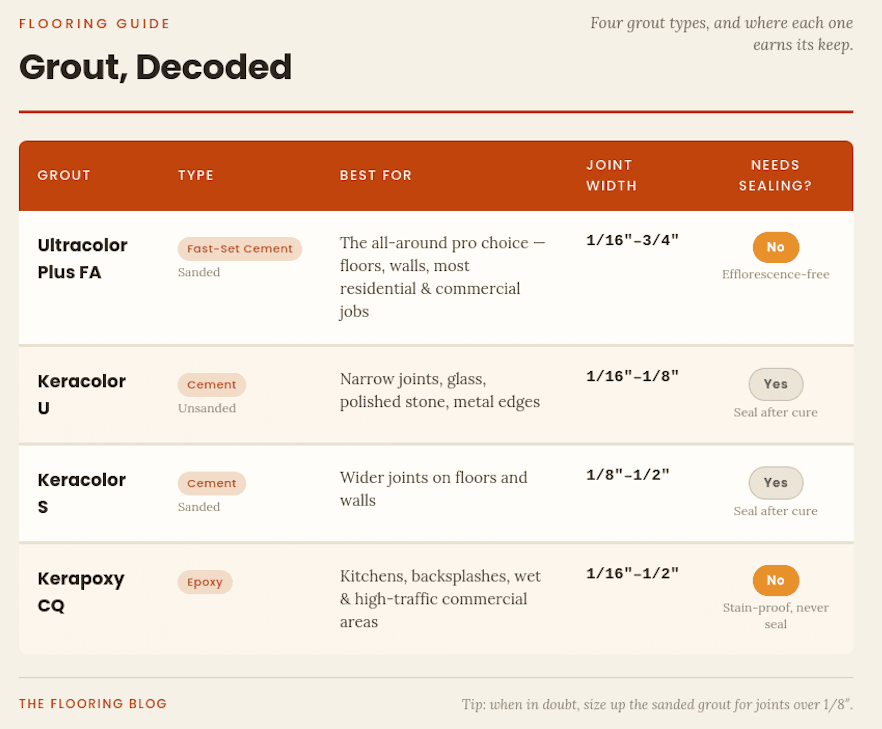
The short version: For most projects, Ultracolor Plus FA is the sweet spot — it sets fast, resists efflorescence and stains, and skips the sealing step. Step up to Kerapoxy CQ when you need a fully stain-proof, chemical-resistant joint. Reach for Keracolor U/S when you want a proven, budget-friendly cement grout.
Mapei grout colors & color chart
Mapei’s premium grouts come in a coordinated 40-color palette that runs across Ultracolor Plus FA, Kerapoxy CQ, and the Mapesil T Plus silicone caulk — so your grout, joints, and caulk can all match. Keracolor is offered in a focused set of 13 core neutrals.
That shared palette is the reason pros like the Mapei system: pick a color once, and you can carry it from the floor grout to the change-of-plane caulk without hunting for a match. Popular neutrals include Warm Gray, Silver, Pearl Gray, Charcoal, Biscuit, and Bone, with the full range spanning bright whites through true black.
A few tips when choosing a grout color:
- Match the tile for a seamless, larger-looking surface.
- Contrast the tile to make a pattern (like a herringbone or subway layout) pop.
- Go slightly darker than your tile on floors — it hides dirt and wear far better than a bright white.
Every product page on our Mapei grout collection shows its live color options, so you can see the exact palette before you buy.
How much grout do I need?
The amount of grout you need depends on four things: tile size, joint width, joint depth (tile thickness), and total square footage. Smaller tiles and mosaics have more joints per square foot, so they use dramatically more grout than large-format tile.
A simple way to estimate:
- Measure your total tiled area in square feet.
- Note your tile size and joint width.
- Check the coverage chart on the grout bag (or the product page) for your tile/joint combination.
- Divide your square footage by the bag’s coverage — and round up so you don’t run short mid-job.
As a rough directional example, a 25 lb bag of sanded cement grout might cover on the order of 100–200 sq ft of standard 12″×12″ floor tile with ⅛″ joints — but that number drops fast with smaller tile or wider joints. Always confirm against the manufacturer’s coverage chart for your exact tile before ordering.
Beyond grout: the rest of the Mapei line we stock
Grout is only the finish line. Flooring Market carries the Mapei products that get you there, too:
- Mortar & thinset — Ultraflex 1, Ultraflex 2, and Ultraflex LHT (large-and-heavy-tile) polymer-modified mortars, plus Kerabond / Kerabond T dry-set mortars, Type 1 mastic adhesive, and Ultrabond ECO 373 for resilient flooring.
- Self-leveling & patching — Novoplan 2 Plus self-leveling underlayment, Primer T, and Planipatch for fast floor repairs.
- Uncoupling membrane — Mapeguard 2, Mapei’s crack-isolation and uncoupling membrane.
- Waterproofing — Mapelastic AquaDefense, a liquid-applied waterproofing and crack-isolation membrane for showers and wet areas.
- Caulk & silicone — Mapesil T Plus 100% silicone, color-matched to the grout palette.
Where to buy Mapei grout
You can buy Mapei grout online at Flooring Market — we stock the full grout lineup (Ultracolor Plus FA, Keracolor U/S, and Kerapoxy CQ) in the complete color range, and ship it to you. No contractor account or supply-house run required. Order the grout, mortar, and setting materials for your whole project in one place, at pro pricing.
FAQs
Does Mapei grout need to be sealed?
It depends on the grout. Ultracolor Plus FA and Kerapoxy CQ do not need a separate sealer — they’re engineered to resist stains and moisture on their own. Standard cement grouts like Keracolor U/S should be sealed after they cure for best stain protection.
Is Ultracolor Plus FA an epoxy grout?
No. Ultracolor Plus FA is a fast-setting, polymer-modified cement grout — not an epoxy. It delivers many epoxy-like benefits (efflorescence-free, stain-resistant, no sealer needed) while staying as easy to install as cement grout. For a true epoxy, chooseKerapoxy CQ.
What’s the difference between sanded and unsanded grout?
Sanded grout contains fine aggregate and is used for wider joints (about ⅛″ and up). Unsanded grout is smoother, used for narrow joints (up to ⅛″) and for delicate surfaces like glass, metal, and polished stone that sand could scratch.
How long before I can seal or walk on Mapei grout?
Cure times vary by product and conditions, but Ultracolor Plus FA is a fast-setting grout designed to return to service quickly. Always follow the cure and sealing times on the product’s technical data sheet for your specific conditions.
What is Mapei Ultracare Grout Refresh?
It’s a colorant-and-sealer-in-one used to renew or recolor existing grout lines — great for freshening up tired grout without regrouting. We stock it in the same 40-color palette as the grout.
Cement or epoxy grout — which should I choose?
Choose cement (Ultracolor Plus FA) for most floors and walls: easier to install and budget-friendly. Choose epoxy (Kerapoxy CQ) for kitchens, backsplashes, and wet or high-traffic areas where a fully stain-proof, chemical-resistant joint matters most.